

Evaluating High-Limit Liability Policies: A Business Owner's 2026 Guide
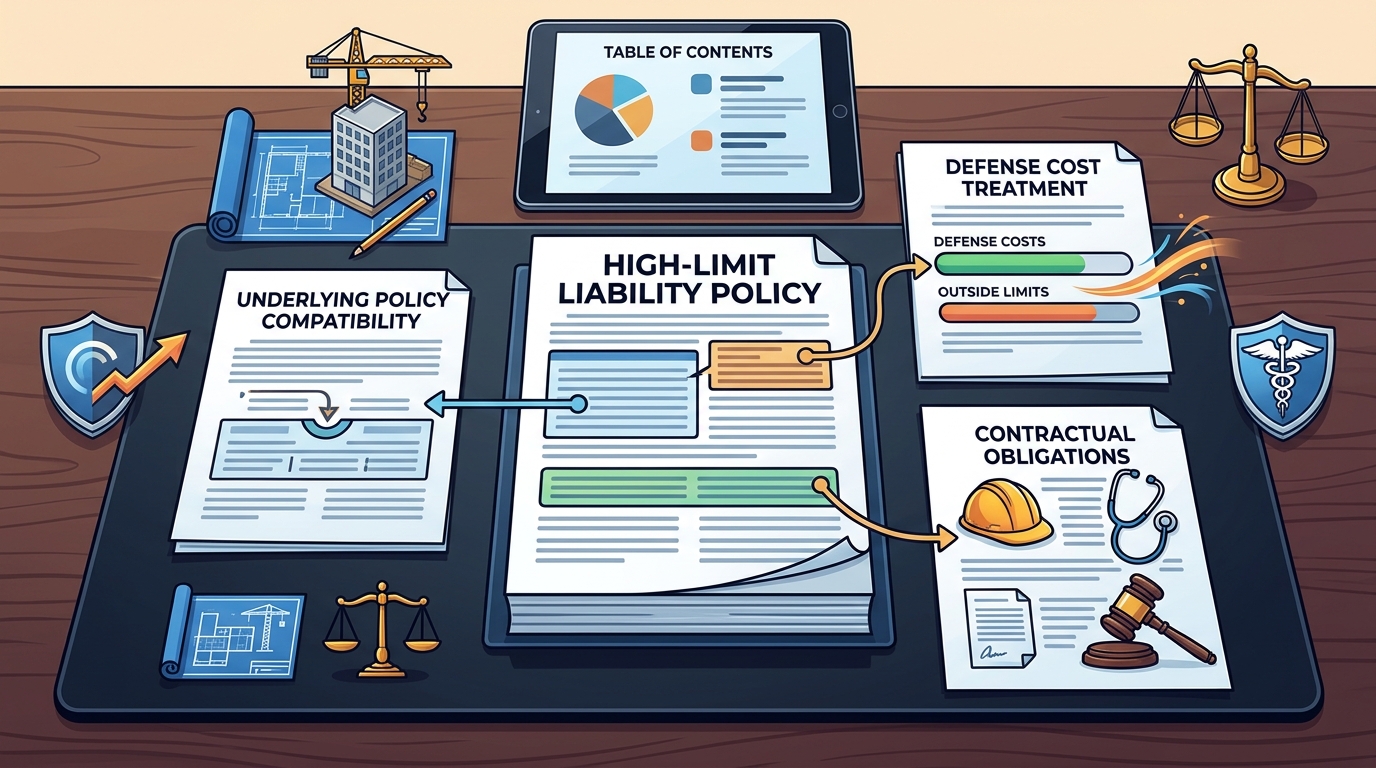
When evaluating a high-limit liability policy, business owners must prioritize underlying policy compatibility, defense cost treatment, and specific contractual obligations. These three factors determine whether the excess coverage actually responds when a claim arises. This guide details how to assess these critical components to ensure your risk management strategy is robust and aligned with your operational realities.
Underlying Policy Requirements
A high-limit liability policy, often referred to as an umbrella or excess policy, is a form of insurance that provides additional coverage above the limits of an underlying primary policy. It does not stand alone. It requires a specific, qualifying primary policy to be in force at the time of the loss. If the underlying policy is cancelled, lapses, or does not meet the specific requirements of the excess policy, the excess coverage may not respond. This dependency is the first and most critical factor to evaluate.
Matching Coverage Types
The excess policy must sit directly on top of a compatible primary coverage. For example, a Commercial General Liability (CGL) umbrella must sit on top of a CGL primary policy. A Professional Liability For additional details, see Errors and Omissions. umbrella must sit on top of a Professional Liability primary. You cannot use a CGL umbrella to provide excess coverage for a Professional Liability claim. Click Insurance helps clients identify the correct primary coverage types that align with their specific business risks, ensuring the excess layer is properly anchored.
Limit and Deductible Alignment
Policy Period and Renewal Continuity
Most high-limit liability policies are written on a claims-made basis. This means they cover claims made during the policy period that arise from acts committed during that period. If you change carriers or let your underlying policy lapse, you may lose coverage for claims made in the future, even if the underlying act occurred in the past. Maintaining continuity of coverage, or purchasing a tail policy if you switch carriers, is essential. Click Insurance advises clients on the importance of maintaining continuous coverage to avoid gaps in protection.
Defense Cost Treatment
Defense cost treatment is a critical factor that determines how legal fees and other defense expenses are handled within your policy limits. There are two primary ways defense costs are treated: eroding limits and non-eroding limits. Understanding which structure your policy uses is essential for evaluating the true value of your coverage.
Eroding Limits
Non-Eroding Limits
In a non-eroding limits policy, defense costs are paid in addition to the policy limits. This means that the full limit amount remains available for settlements or judgments, regardless of how much is spent on defense. This structure is generally more favorable to the insured, as it preserves the full value of the coverage for the actual loss. However, non-eroding limits are less common and may come with higher premiums. When comparing high-limit liability policies, always ask how defense costs are treated. This single factor can dramatically change the effective value of your coverage.
Outside Counsel and Panel Requirements
Some policies require the insured to use a panel of approved attorneys, while others allow the insured to choose their own counsel. Using outside counsel may require prior approval from the insurer. If you use an attorney who is not on the approved panel, the insurer may not cover the defense costs. This can lead to significant out-of-pocket expenses. When evaluating a policy, review the defense cost provisions carefully to understand any restrictions on counsel selection and approval processes.
Contractual Requirements
Many business contracts, particularly in construction, healthcare, and professional services, require specific insurance limits and types. These contractual requirements are a key factor in evaluating a high-limit liability policy. If your policy does not meet the contractual requirements, you may be in breach of contract, which can lead to legal liability and loss of business opportunities.
Specific Limit and Type Mandates
Additional Insured and Waiver of Subrogation
Certificate of Insurance (COI) Accuracy
A certificate of insurance is a document that proves you have the required coverage. It is not a policy and does not create coverage. However, it is often required by contract. The COI must accurately reflect the limits, types, and endorsements of your policy. If the COI is inaccurate, it can lead to disputes and potential breach of contract. Click Insurance provides accurate COIs to clients to help them meet their contractual obligations. Remember that a COI is for informational purposes only and does not guarantee coverage.
Comparison of Liability Structures
The following table summarizes the key differences between primary and excess liability policies, highlighting the factors that should be evaluated.
| Factor | Primary Liability Policy | High-Limit (Excess) Liability Policy |
|---|---|---|
| Dependency | Stands alone | Requires a qualifying underlying policy |
| Defense Costs | Often eroding | Can be eroding or non-eroding |
| Contractual Endorsements | Must include required endorsements | Must mirror primary policy endorsements |
| Policy Form | Various (ISO, non-ISO) | Usually excess form |
| Cost | Higher per unit of coverage | Lower per unit of coverage |
Key Takeaways
- A high-limit liability policy is dependent on a qualifying underlying primary policy.
- Defense cost treatment (eroding vs. non-eroding) significantly impacts the effective value of your coverage.
- Contractual requirements must be met by both the primary and excess policies.
- Additional insured and waiver of subrogation endorsements must be present in both layers.
- Continuity of coverage is critical for claims-made policies to avoid gaps.
- A certificate of insurance is for informational purposes only and does not create coverage.
- Click Insurance helps clients navigate these complex factors to ensure their risk management strategy is robust.
Frequently Asked Questions
What is a high-limit liability policy?
A high-limit liability policy is an excess insurance policy that provides additional coverage above the limits of an underlying primary policy. It is designed to protect against large claims that exceed the primary policy limits.
Does a high-limit policy stand alone?
No, a high-limit policy does not stand alone. It requires a qualifying underlying primary policy to be in force at the time of the loss. If the underlying policy lapses, the excess coverage may not respond.
How are defense costs treated in a high-limit policy?
Defense costs can be treated as eroding or non-eroding. In an eroding policy, defense costs reduce the policy limits. In a non-eroding policy, defense costs are paid in addition to the limits, preserving the full limit amount for settlements.
Do I need to add additional insureds to my excess policy?
What is a waiver of subrogation?
A waiver of subrogation is an endorsement that prevents the insurer from seeking reimbursement from the other party after paying a claim. It is often required by contracts to protect the other party from being sued by the insurer.
Can I use a CGL umbrella for Professional Liability claims?
No, you cannot use a CGL umbrella for Professional Liability claims. The excess policy must sit directly on top of a compatible primary coverage type. A CGL umbrella must sit on a CGL primary, and a Professional Liability umbrella must sit on a Professional Liability primary.
How does Click Insurance help with high-limit liability policies?
Click Insurance helps clients evaluate their underlying policies, defense cost treatment, and contractual requirements to ensure their high-limit liability policy is properly structured and meets all obligations. We work with multiple carriers to find coverage that fits your specific needs.
Conclusion
Evaluating a high-limit liability policy requires a careful analysis of underlying policy requirements, defense cost treatment, and contractual obligations. These factors determine whether your excess coverage will respond when you need it most. By understanding these critical components, you can ensure your risk management strategy is robust and aligned with your business goals. Click Insurance is here to help you navigate these complexities and find the right coverage for your business. To discuss your specific needs, .